
History of Loss Transfer History
In the mid to late 1980s, the Ontario Legislature was developing a no-fault automobile insurance scheme to replace Ontario’s tort-only system. As part of the review process, the government retained The Honourable Mr. Justice Coulter A. Osborne to conduct an inquiry into motor vehicle accident compensation in Ontario. Justice Osborne delivered his report on February 11, 1988, titled Report of Inquiry into Motor Vehicle Accident Compensation in Ontario.[1]
Justice Osborne recognized the problems that motorcycles posed in a no-fault scheme:[2]

At page 51[3], Justice Osborne proposed subrogation to deal with the “severe premium” issue the no fault scheme would impose on insuring motorcycles.
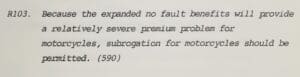
At page 590[4], Justice Osborne discussed the difference in increased premiums on motorcycle policies if the Legislature adopted subrogation:

In the November 9, 1989 session of the Legislature, the Minister of Financial Institutions defended Bill 68 (OMPP) by advising that the government had accepted the recommendations of Justice Osborne (and others):
Hon Mr Elston: It does seem to me that it is well within the public policy interests of the province to move forward with this. The member and his cohort the member for Leeds-Grenville (Mr Runciman) have been among the large number of people who have said we must get on with it and move more quickly than we have before, that there has been enough study. I agree with him and I agree the member for Leeds-Grenville. I agree with the member for Welland-Thorold (Mr Kormos) who says that we have taken too long to study and too much has been done when questions of affordability are at stake. I agree with all of that and, as a result, I am quite pleased to move forward with the legislation.
We have had the Slater report, the Osborne report, the report of the Ontario Automobile Insurance Board. We have had all kinds of input and we have accepted the recommendations which they have put as part of the process to establish the bill and in fact have made good use of the input from various parts of the public that have come before us: the consuming groups, people who represent the injured, people from the industry, people from the legal groups, people from the broadest perspective in the province. The bill is a balanced and rational way to come up with both affordability and good benefit levels to support the people in the province.[5]
Loss transfer was born from Justice Osborne’s report. His proposed subrogation scheme was codified in section 275 of the Insurance Act and section 9 of Reg 664 – not just with respect to reimbursement, but also with respect to fault (subrogation depends on fault).
Justice Spiegel adopted the statements in OIC Bulletin 11/94 about the purpose of loss transfer, which are consistent with Justice Osborne’s concerns about the cost implications no fault automobile insurance would cause to certain classes of automobiles (i.e., motorcycles):
In my view, the conclusion I have reached is consistent with the purpose of the loss transfer indemnity scheme. I accept as correct the following statement of the Ontario Insurance Commission in its Bulletin 11/94 dealing with Loss Transfer at page 2:
Loss transfer was introduced in June, 1990, in order to address the cost implications of moving away from tort-based compensation and to a first party accident benefits provided on a no-fault basis.
Since June, 1990, insureds look to their own insurers for accident benefits instead of seeking compensation from third parties. Certain types of vehicles that might have been less likely to experience bodily injury claims under a tort-based compensation system are more likely to require accident benefits payments for such claims under a no-fault system. Loss Transfer balances the cost of providing compensation on a first party basis between these specified classes of vehicles.
The Legislature recognized that insurers of certain classes of automobiles such as motorcycles and snowmobiles will bear inordinately high costs of providing SABs because their drivers are more likely to suffer serious personal injuries than the drivers of other classes of automobiles. The loss transfer indemnity scheme set out in s. 275 is meant to shift those costs in some circumstances from the first party insurer to the second party insurer. …[6]
[1] Attorney General of Ontario and the Ministry of Financial Institutions, Report of Inquiry into Motor Vehicle Accident Compensation in Ontario, The Honourable Mr. Justice Osborne, Commissioner, Vols. I, II (1988), RDB – Tab 1
[2] Osborne at 23, RDB – Tab 1
[3] Osborne at 51, RDB – Tab 1
[4] Osborne at 590, RDB – Tab 1
[5] Ontario House Hansard, Session 34:2, http://hansardindex.ontla.on.ca/hansardeissue/34-2/l067.htm, RDB – Tab 2
[6] Jevco Insurance Co. v. Wawanesa Insurance Co., 1998 CarswellOnt 4669, 1998 CanLII 14712 (ON SC), https://canlii.ca/t/1vvkw at para 28